

What Do You Call Yourself When Nothing Fits?
An eclectic seeker's guide to choosing a spiritual label that feels honest, useful, and authentic

A few days ago, I found myself staring at my Facebook bio longer than any reasonable person should. I try to update it (and all my social bios) every so often to make sure it still fits, especially if anything about my content or online persona has been changing.
Well, things have been changing, so I decided it was time for at least a minor update, but… to what?
Most of us have probably been there, though. A social media profile gives you a scant handful of characters and asks you to summarize your entire human life within those parameters. So, you choke, because who can comfortably do that?
Not me!
Lately, I’ve been working on integrating all aspects of who I am online a little more thoroughly. Part of that has meant talking about the freelancing I do for my living more openly. Another part has found me opening up more about my spiritual identity, especially as I continue to explore publishing and monetization opportunities on that front.
The bio conundrum basically forced me to try to sum my entire spiritual life up in a single word or two, and I honestly wasn't sure what fit. Occultist? Witch? Gnostic? Mystic? Esotericist? Something else entirely?
Each option I might choose felt close while also feeling woefully incomplete.
I imagine a lot of people on unconventional spiritual paths eventually run into the same problem. The more books you read, the more traditions you explore, and the more experiences you gather, the harder it becomes to answer a seemingly simple question:
"So what are you?"
So how does someone like me (who is really many things on a spiritual level) choose a label that feels honest without also misrepresenting themselves?
Why Finding the Right Label Is Impossible
I find that every spiritual label acts a little like a flashlight. Point it at a person and certain details come into focus while others remain in shadow.
For example, the word “witch” might suggest practical magic, folk traditions, spellwork, or a connection to nature. “Mystic” often brings to mind direct spiritual experience and contemplation. “Gnostic” points toward a particular theological lens. Meanwhile, “occultist” suggests a broader interest in hidden knowledge, esoteric traditions, and spiritual study.
Each term communicates something useful. But each term also leaves something out, and that's exactly where seekers get stuck. They begin searching for a word capable of capturing every belief, practice, influence, and book on the shelf. Every ritual they've ever performed, and every idea they've ever entertained.
Such a word would need its own glossary.
But thankfully, a label doesn't necessarily need to tell your entire story. It just needs to point people in roughly the right direction. “Good enough for government work” will do.
What Is the Label Actually For?
It helps to understand what labels do. Most people treat them as identities. But in practice, they work better as signposts.
Labels offer clarity at a glance
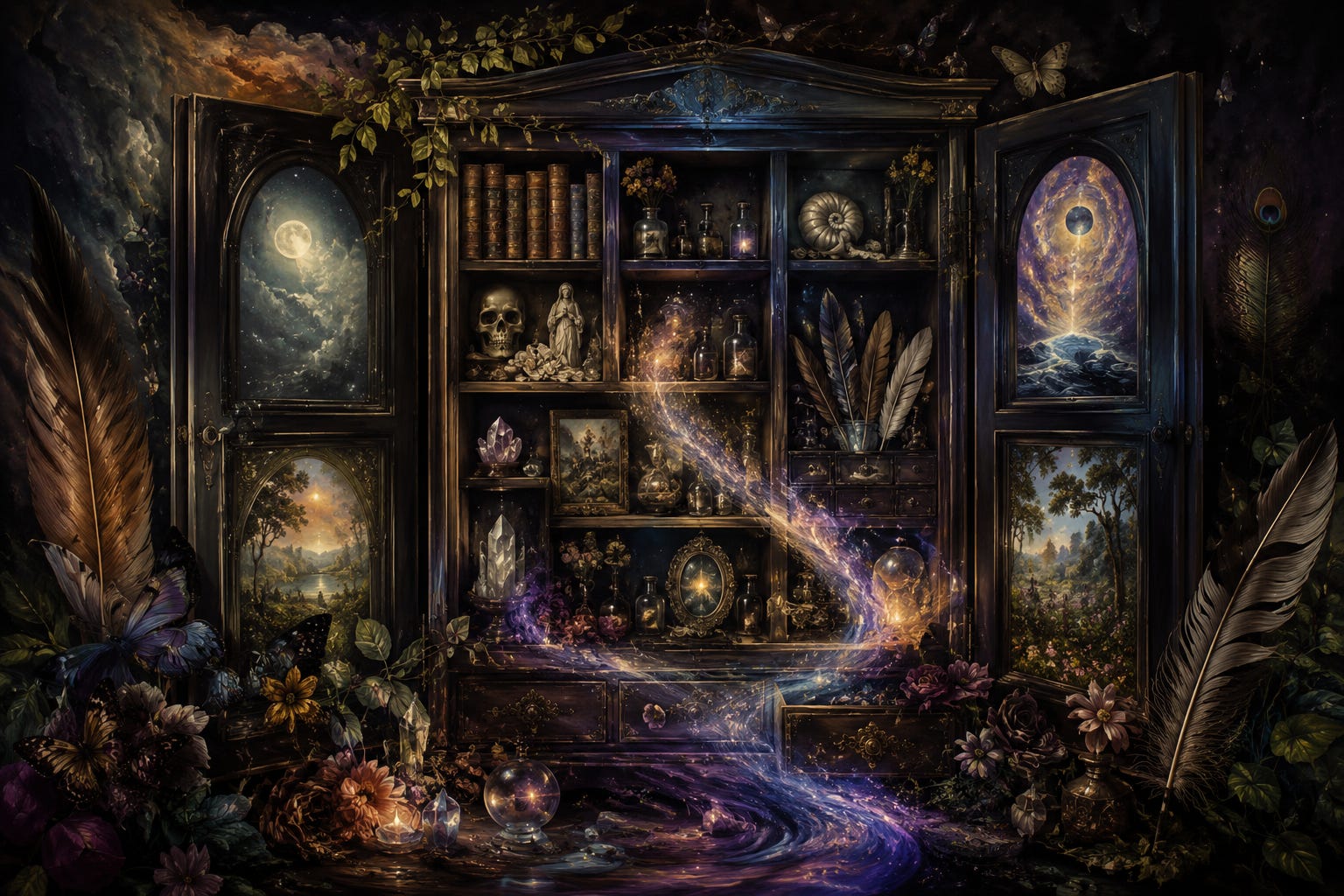
Imagine a curiosity cabinet filled with books, relics, maps, feathers, bones, journals, talismans, photographs, and an entire host of strange objects collected over a lifetime. A small brass plaque on the front might read Natural History or Occult Studies or even just Curiosities.
That plaque serves a very specific purpose. It gives visitors a general sense of what they're about to encounter. It doesn't explicitly inventory every object inside.
Spiritual labels work the same way.
Labels also act as filters
Different words start different potential conversations.
A person who describes themselves as a Christian mystic may invite one set of assumptions, while someone who identifies as a witch will almost certainly inspire entirely different questions. An occultist might find the dialogues they attract fall somewhere in the middle.
Labels facilitate a filtering process that isn't inherently good or bad. It's simply part of how humans streamline communication in a world increasingly overstuffed with information. Every possibility opens certain doors, perhaps closes others, and directs attention toward particular aspects of your path.
I know I tend to choose my own labels according to who I do (and don't) want to attract into my space. I want my vibe to attract my tribe, but I also want to inspire people who won't appreciate what I'm about to nope right off immediately.
It's a time saver, really.
A Few Questions to Ask When Choosing a Label
No clue what label even might be right for you? Been there, and more than once. I've found it useful to ask a few practical questions.
1. Does it cover what you actually do?
Start with the everyday realities of how your spirituality manifests itself in your life:
What subjects occupy most of your spiritual attention?
What books fill your shelves?
What practices show up repeatedly in your daily, weekly, or seasonal routines?
What communities do you participate in?
I’ve noticed a lot of people choose labels based on aspiration rather than experience. They gravitate toward words that sound intriguing, impressive, mysterious, ancient, or profound.
But your actual practice usually offers much better clues.
For example, a person who spends most of their time studying folk magic, performing spellwork, and participating in witchcraft communities may find that “witch” feels like a natural fit. But someone deeply immersed in contemplative prayer and direct spiritual experience may resonate more strongly with “mystic.”
2. Does it feel natural when you say it?
A technically accurate label can still feel super awkward when it's actually coming out of your mouth (digitally or otherwise). Some words may fit comfortably from the moment you try them on, while others totally feel like borrowing someone else's coat.
So pay attention to your reaction:
Does the label create a sense of ease?
Does it feel authentic?
Would you be able to use it in conversation without launching into a lengthy explanation afterward?
I’ve noticed my body usually clocks a mismatch long before my brain really catches up.
Of course, this doesn't mean you should chase comfort exclusively. Growth often involves stretching beyond familiar territory, or at least that's been the case for me.
3. Does it start conversations you’re actually interested in having?
As a lifelong label avoider, this is probably the realization that most drastically changed the way I think about (and use) labels. Every label functions as a conversation starter.
When someone reads a spiritual label in your bio, they're already forming expectations about the kinds of topics you probably enjoy enjoy bringing up for consideration.
Think about the interactions you hope to have, versus the ones you’d rather avoid:
What subjects energize you?
What questions do you enjoy answering?
What communities feel most aligned with your interests?
A useful label helps guide people toward those conversations while also steering them away from others you're less interested in.
4. Are you choosing it because it fits or because it feels safe?
Sometimes a practitioner might reject a label because it genuinely doesn't fit. Other times, a label gets rejected because it feels a little too accurate. Family expectations, workplace concerns, social pressures, and cultural assumptions can all influence how openly we describe ourselves.
I know that for a long time I preferred maintaining a very hard boundary between my work life and my personal life.
Clients and professional peers generally knew little to nothing about who I was outside of what I did for them, and personal acquaintances didn't really know much about what I did for a living. I even used pseudonyms and made-up personas to make sure those boundaries stayed intact and make it harder for people to dig into aspects of my life I hadn't explicitly chosen to share with them.
But things are different now.
At this point, I'm friendly with some of my current and former clients outside of work. Some of them even follow my personal publications and I follow theirs. Who I am as a person has become a bigger part of why people hire me in the first place, especially now that expansive AI use is totally a thing.
I’ve also learned that people are way less judgemental than I once thought. The right people, anyway. (To hell with the wrong ones.)
So, imagine a world where nobody would judge your answer to the whole “what are you” spiritual question.
Which label would you choose then?
The Label on My Cabinet
If you're someone who's followed me or my life for very long, then you already know I’ve considered myself to be a lot of things over the years, spiritually speaking. I’ve been at least a little bit witchy and very interested in the supernatural ever since I was a kid.
But a lot of what I'm about was (and sometimes still is) all wrapped up in certain aspects of Catholicism and Christian mysticism.
Depending on which aspects of my spiritual life were most prominent at the time, I’ve worn lots of labels over the years, including Catholic, pagan, gnostic, and theosophist. (Sometimes I would wryly tell people I was “Catholic Plus” and let them sort out what that means on their own.)
But eventually, I realized I was asking the wrong questions. So instead of over-focusing on accuracy, I decided a better thing to ask myself was:
Which label am I comfortable saying out loud?
I guess that's why I’ve settled on “occultist” for now, as far as a lot of my bios go. It gets the point across and ensures the conclusions people jump to about me are at least somewhat accurate. It also invites curiosity from people on my wavelength, while also scaring the rigid fundamentalists enough that they stay out of my orbit entirely.
Now, will that still be the label I use ten years from now? Your guess is as good as mine. Spiritual paths have a habit of wandering into unexpected territory, and I've never been particularly good at staying in one lane.
For the moment, though, it fits fine and points folks in the right direction. Anyone curious enough to open the cabinet door can discover the rest for themselves.