

10 Things About Time That Don’t Work the Way You Think They Do
A quick and dirty dismantling of the “past → present → future” story

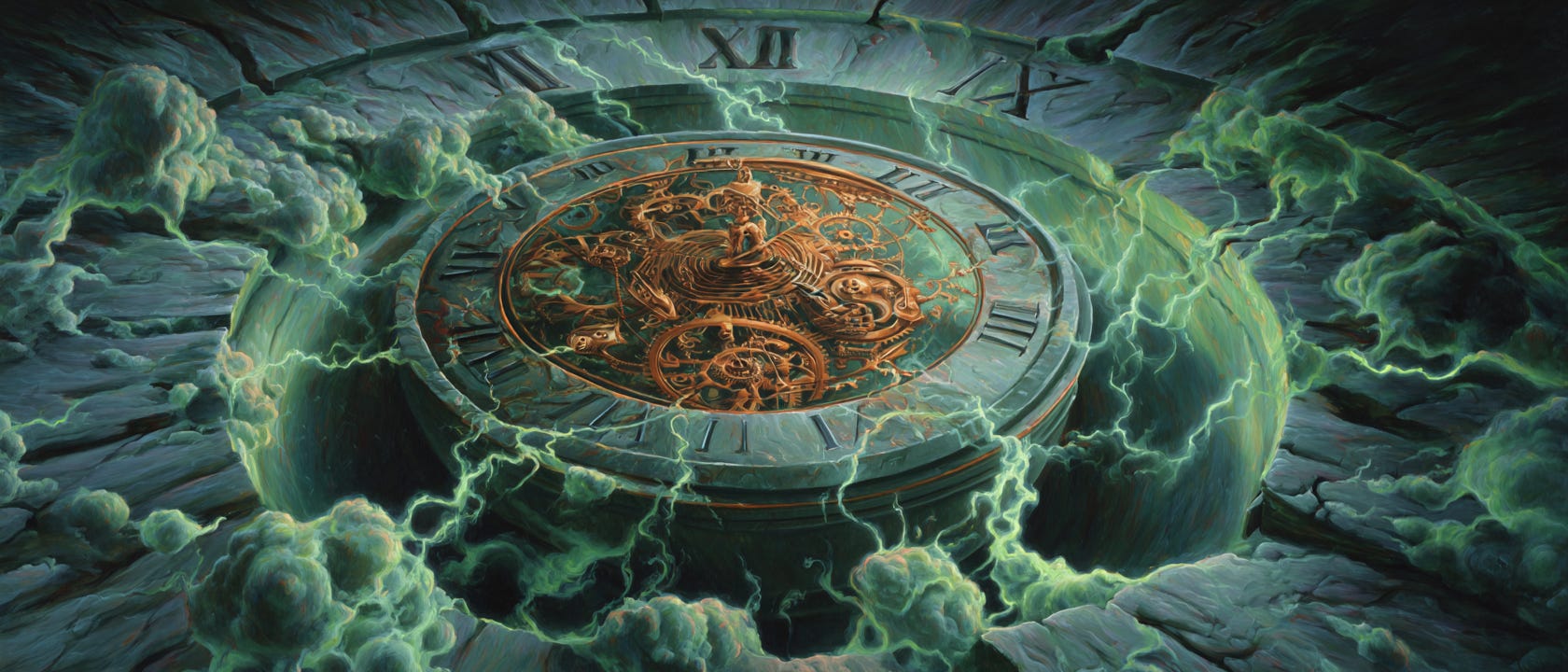
Have you ever had one of those weird, wonky moments where time didn’t really behave the way it was supposed to? Because I stopped thinking stuff like that was “just me” a long time ago (and have also thought about why such things happen much more often than I care to admit).
The moments I’m talking about aren’t anything crazy. No clock-stopping involved or sudden revelations that wouldn’t be out of place in a time-travel blockbuster. I’m talking small, subtle misalignments here. A sense that what’s happening and what should be happening aren’t quite the same thing.
Once you start noticing things like that, it becomes difficult to fully believe in the version of time you were handed by polite society. So, on that note, allow me to share a few observations about time as I have come to understand it.
1. Time isn’t a river, it’s a landscape
Most people see time as a current carrying them forward. That’s a really comforting lie, though.
A better way to look at things? Picture a vast terrain where everything already exists — past, present, future — all laid out like various dishes at a potluck. Your consciousness is the thing moving, like a traveler with a lantern, illuminating one patch at a time.
Because the so-called mystics among us don’t “predict the future.” They climb to higher ground to help themselves see further across the landscape.
2. Your past isn’t fixed, it’s stabilized
You’ve felt it, haven’t you? I know that you have. Memories morphing or warping. Events feeling ever so slightly re-authored at will.
From a deeper perspective, the “past” is not a locked vault. It’s actually a pattern that becomes more rigid as more and more minds agree on it. But at the edges (your personal edges), it’s a lot more malleable. That’s why trauma recovery, shadow work, ritual, and even storytelling can eventually change how the past behaves in your present.
Don’t think of this as rewriting history. You’re actually selecting which version of it is the heaviest.
Most of this is learned sideways.
3. Timelines split constantly (and most of them die)
Every decision, every hesitation, and every almost-action creates its own never-ending series of branching paths. But people fail to fully understand that most of those paths eventually collapse. They lose energy, coherence, and attention, becoming ghost-paths in the process.
Sometimes, in dreams or fleeting episodes of déjà vu, you might brush against one of those abandoned branches. It feels a little bit like walking through a house you almost lived in.
4. Déjà vu is a memory leak
That sudden “I’ve been here before” feeling? One explanation for you — your awareness briefly syncs with a neighboring timeline where that moment already unfolded. For just a second, you’re holding two versions of the same event, and your mind can’t reconcile them cleanly.
So it translates the situation into something chewable and familiar instead. “This has already happened.” And in a sense, it has.
If something here feels familiar, don’t rush past it.
5. Spirits don’t experience time the way you do
Fellow practitioners may already understand that entities — whether you call them spirits, intelligences, or something else — don’t move through time linearly. So to them, your entire life feels like a single object, as opposed to a sequence.
That’s why communication with them often feels so symbolic, layered, out of order, or just plain mysterious. Because they aren’t ever speaking from “now”. They’re interacting with your whole pattern at once. You’re the one translating the whole affair into before and after.
6. Reincarnation isn’t always sequential
Most people who believe in at least the possibility of reincarnation assume that you live, you die, and you’re reborn later, right? But if time is a landscape, why assume “later”?
Some traditions subtly suggest that incarnations can (and often do) overlap, echo, or even run parallel to one another. Different versions of “you” potentially exist in different eras simultaneously, sharing a single deeper root.
So, that strange feeling of recognizing someone instantly? Sometimes it isn’t an echo from a past life. It’s from a parallel life that’s happening elsewhere in the same moment.
There are more versions of you out there than you’ve been told.
7. Time speeds up and slows down based on attention, not clocks
Hours have a way of positively vanishing when you’re absorbed, but minutes drag when you’re trapped in something you hate, right? Well, from an occult perspective, attention is a kind of fuel (and a powerful one at that). Where you place it affects how densely time “packs” itself:
More presence = richer, fuller slices of time.
Less presence = thin, slippery time that disappears on you.
Which means, in a very real sense, you are partially authoring the very pace of your life.
8. There are “thin moments” in life when timelines are easier to alter
And you’ve almost certainly sensed these, even if you didn’t have the vocabulary to actually name them at the time.
Late at night, right after waking, during storms, in the middle of a grief cycle, in states of ecstatic joy, or in ritual. These are all liminal thresholds where the laces holding your usual identity together loosen up a little. And when that happens, the glue holding your current timeline together loosens with it.
As a result, small choices made in those moments can ripple much further than they should. That’s why so many traditions emphasize twilight, crossroads, thresholds, and altered states. It’s way more of a practical thing than it is a poetic one.
Pay attention to those times when things feel ever so slightly unreal.
9. The future influences the present more than people ever realize
We’re taught causality flows one way. Past → present → future. But intention, expectation, and fear are all great examples of ways the future reaches backward all the time.
When you strongly believe something is coming, you start to pivot your behavior, perception, and energy toward that version of events. So, you don’t just move toward the future. The future you’re oriented toward also pulls you into it.
10. “Now” is the only place timelines can be altered
The present moment is the junction point, the only place where the actual branching happens. And every version of you that could exist hinges on what you do with this slice of awareness.
That’s why so many spiritual paths, stripped of all language and symbols, end up saying more or less the same thing. “Be here. Fully.” Because “here” is where the machinery of reality is actually accessible.
If any of this is even somewhat true…
… then most people are grossly misidentifying the moments that matter most. And they treat certain hours like filler, something to simply get through on the way to bigger and better things.
But there are points where a small decision is a lot heavier than it normally would be or where razor-focused attention effectively locks something important into place. Points where a small nudge, barely noticeable at the time, alters the entire direction of everything that follows.
None of those moments feels important while you’re inside them, the way you think they will. And that’s the problem.
Time doesn’t warn you when you’re standing at a true crossroads or slow down so you can take your time and choose more carefully. It simply waits to see what you’ll do with where you are.
Most people will read something like this, pause for a second, and then return to their day unchanged, and that’s certainly one way to move through time. But if time is a landscape, then you are already standing somewhere specific inside it right this very second.
You didn’t arrive there by accident. Something to think about as you move through the rest of your day (and the next, and the next), perhaps.
The concept of time is always interesting to think about.